Lesson: the first 5 right-of-way rules
Right-of-way rules in Aruba
Below are the right-of-way rules that apply in Aruba, in order: a rule comes before the rules that follow it. So always look first at the highest rule that applies.
The main order: instructions from the police come before traffic signs; traffic signs come before the rules of conduct; and traffic lights come before traffic signs and road markings.
Rule 1: Instructions from the police
Always follow the instructions of a police officer in uniform, even if a traffic light or sign shows something else. The officer can signal you to stop with hand signals, with a lit sign 'STOP POLITIE' or 'STOP POLIS' on the police car, or at night with a red light moving quickly up and down. Near schools, an appointed school crossing guard can stop traffic so that pedestrians can cross.
Rule 2: Emergency vehicles
An emergency vehicle is a police, fire or ambulance vehicle using flashing lights and a siren. You must always give way to such a vehicle; stop if necessary. An emergency vehicle may drive through a red light if this does not put traffic in danger.
If only the flashing lights are on and the siren is off, it is not an emergency vehicle and the normal rules apply. There is no order of priority between emergency vehicles.
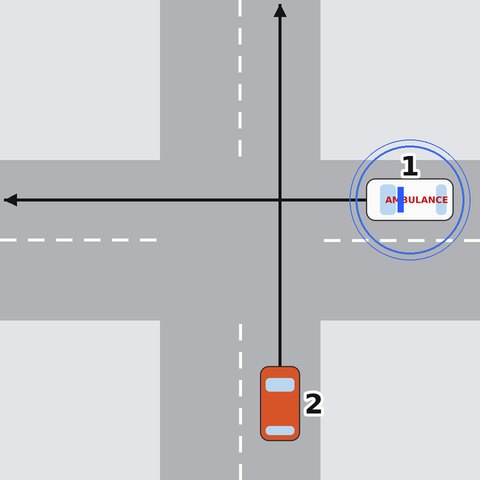
The ambulance (1) has flashing lights and a siren and goes before the car (2), even though the car is not coming from the left.
Rule 3: Traffic lights
- Green: go, but only if you can cross the junction without having to stop on it.
- Amber: stop, unless you are so close to the light that you can no longer reasonably stop.
- Red: stop.
- Flashing amber: take special care. The light then does not regulate right of way; the signs and the normal rules below apply.
- Arrow in the light: the light applies only to that direction.
- Pedestrian light: green = cross; red = do not cross; flashing green = do not start crossing, anyone already crossing continues.
- Lights for scheduled buses and trams: white = go, yellow = stop unless you can no longer do so, red = stop.
Traffic lights come before priority signs. Even when you have a green light, when turning you must give way to oncoming traffic and to pedestrians on the zebra crossing.
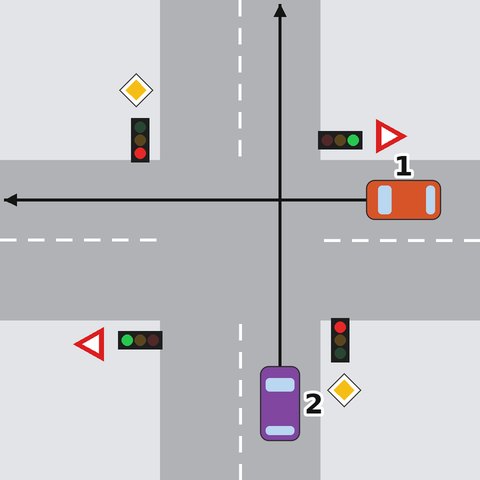
Car 1 has a green light and goes before car 2, even though car 1 has a 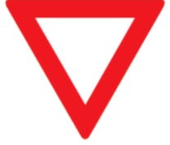 sign and car 2 is on a priority road.
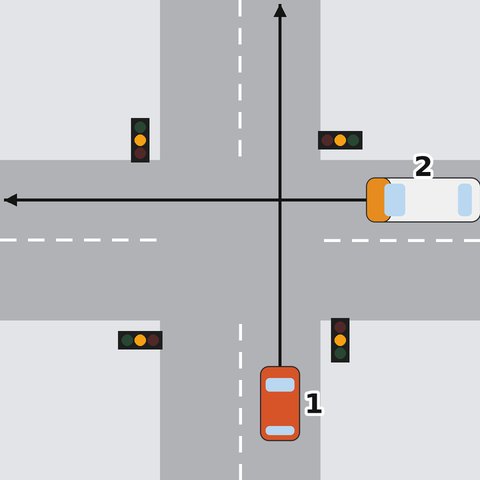
The lights are flashing amber: the normal rules apply. The truck (2) comes from the right and goes before the car (1).
Rule 4: Priority road and priority signs
On a road with sign 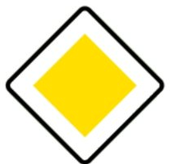 (priority road) or
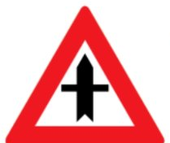 (priority junction) you have right of way over traffic from the side roads. At sign you must give way to traffic on the crossing road; at sign
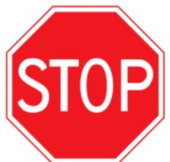 (STOP) you must first stop and then give way. Traffic signs come before the normal right-of-way rules.
Note: the sign is what counts. White triangles painted on the road surface have no meaning of their own in the Aruban rules.
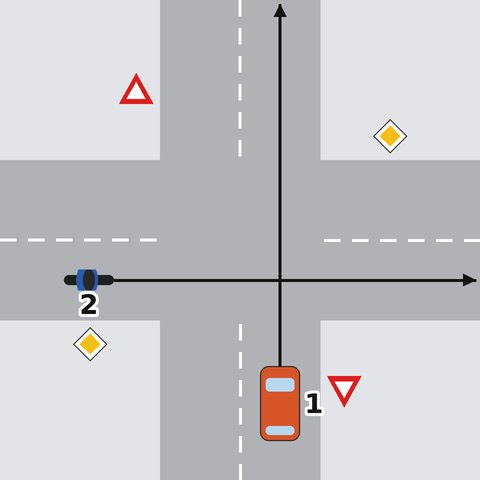
The motorcyclist (2) is on the priority road . The car (1) has sign and must let him go first, even though the motorcyclist comes from the left.
Rule 5: Tram and level crossing
At a level crossing (where a road crosses a rail track) you must always give way to a rail vehicle, such as the tram in Oranjestad. Stopping on a level crossing, a railway or a reserved lane is prohibited. A reserved lane may only be used by trams, scheduled buses and emergency vehicles.
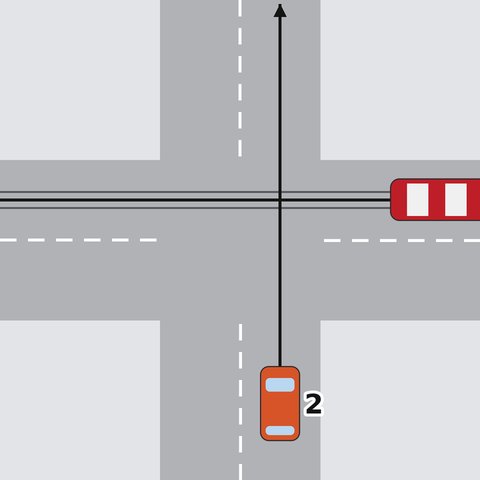
The tram (1) goes before the car (2): at a level crossing the tram always has right of way.
The other nine rules, with drawings and over 250 practice situations, are in the complete course and the right-of-way trainer.